|
Tour
of Thomassique, Haiti | Thomassique, Haiti, lies in the Central Plateau, about 20 miles west of the border between
Haiti and the Dominican Republic. It is a city of more than 65,000 people, about half of which live in the city limits,
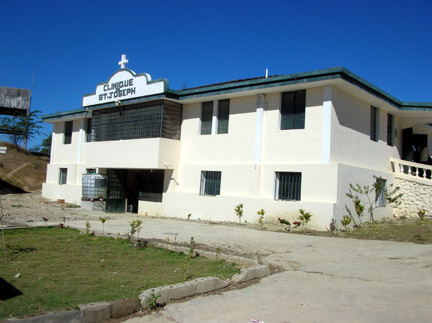
while the other half live in six outlying villages. | Thomassique is home to the St. Joseph Clinic, built and supported by Medical Missionaries. Prior to the construction
of the Clinic in 2006, Thomassique had no permanent medical facility. Now it boasts one of the best health facilities
in that region of Haiti. | This tour
of Thomassique is not focused on the Clinic but rather on Thomassique itself. The tour will introduce you to the people
and lifestyles of the city and its outlying villages. First, some background information: Most of the population lives
on subsistence farming; only about 5% to 10% are employed outside the home. The average per capita income is less than
$700 per year (compared to about $40,000 in the U.S.). The average life-span is 61 years (compared to 78 in the U.S.).
Less than 40% of the homes in the city and less than 15% of the homes in the outlying villages have water (usually outside
the front door), and less than 10% of the homes have sanitation (i.e., a latrine on their property). |
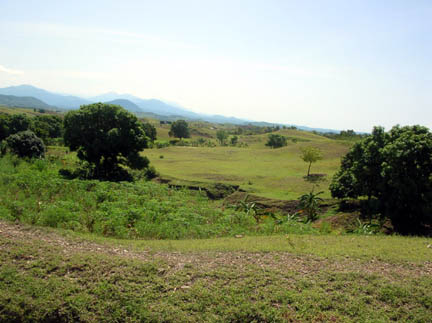
The countryside surrounding Thomassique can be breathtaking. The look of it varies, depending on the
season of the year. In Thomassique, there are two seasons: the rainy season (from May through October) and the dry season
(from November through April). During the rainy season, the countryside looks green, as wild grasses cover
much of the landscape. |  |  | During the dry season, the land turns brown. Most of the fields and hills of the area are only dotted with occasional
trees and bushes. Throughout almost all of Haiti, the trees have been cut down to make charcoal, which is used for cooking.
Now, however, there are few remaining trees and they are running out of charcoal. Cutting down the trees has
also created another problem: soil erosion. The quality of the soil is now so bad in many places that it is not possible
to grow food crops. |
There are exceptions, however, as seen in this healty-looking crop of
ocra. |  |  | The church plays
an important role in Thomassique and some of the best buildings in the city are the churches and church-related schools. This Catholic church (St. Thomas) was built in 2004 by the present pastor, Fr. Ronel. Funding was provided
by a "twin" parish in Nashville, TN. Construction took less than 12 months from start to finish. |
This school is part of St.
Thomas parish. It is a new wing to the original school that was constructed in the 1970s by the then-pastor, Fr. Mark,
a renouned Belgian priest who served Thomassique for 34 years. The year after this wing was built (2007), the original
building was completely renovated (2008) to better serve the 1,300 to 1,500 students who study here. Students pay about
$50 per year to attend this school, a sum that is beyond the reach of most families in the area. Some of the costs of
running the school are subsidized by a U.S. "twin" parish. The cost of a mid-day meal is also subsidized by
U.S. benefactors. |  |  | Children who cannot afford to go to a private school might have to attend classes in classrooms such as this one in Thomassique. |
The people of Thomassique live in conditions that are hard for us to imagine. Those who live within the
city limits have houses like this one, on lots that appear to be about one-half acre. They might have water at their
front door, although the water system is broken in half of the city and none of the water is potable without treatment.
A family of six to ten people would live in this house. | |  |
The quality of housing deteriorates for the most part in the outlying villages. The houses are often made of mud and
sticks and have mud floors and thatched roofs. Again, a family of six to ten people would live in this house.
They have to walk anywhere from a mile to three or four miles to get water. It is often the job of the children to fetch
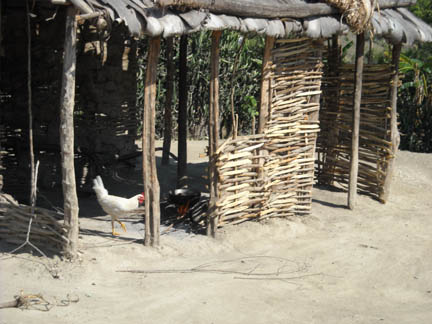
the water each day. | Most of the houses in the outlying villages rely on outdoor kitchens such as
this for the preparation of meals. |  |  |
Only a small percentage of the houses in Thomassique have sanitation, latrines such as this one. |
One woman we visited showed us the latrine she has under construction. She had to halt construction because she
had no more money to pay the men who were digging the hole for her. They have completed digging about four feet of the
ten feet needed. |  |  | Water
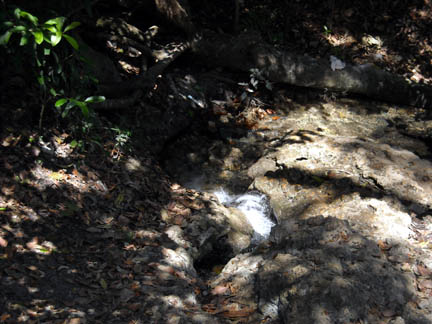
is a precious commodity throughout Haiti. All of the water for Thomassique originates at this spring, which is about
17 kilometers east of Thomassique. About 35 years ago, Fr. Mark built an aqueduct from this source through the middle
of Thomassique. It also serves the communities of Saltedere and Circa la Source. | Along the aqueduct, which generally runs parallel to the
road to Thomassique, are several public fountains, known as "tiyos." People (usually children and women) hike
long distances from their homes to the tiyos to get a day's supply of water. Some also use the tiyos for bathing.
Some homes within the city limits of Thomassique have a water pipe directly to the home, a single spigot outside the front
door. |  |  | None of the water
delivered by the aqueduct is safe to drink, being contaminated by people and animals near the source. Medical Missionaries
has begun a program to educate the people of Thomassique (especially mothers) about the importance of purifying water for
drinking and cooking, and is providing families with a simple, home-based water purification system. |
For most people,
transportation in Thomassique is by foot, even when they have heavy or bulky loads to carry. |
 |  |
A few of the more wealthy families own a mule, which can be the source of transportation for the entire family. |  |  | Some
of the younger members of the community have motor bikes. A variety of transportation modes is often seen at the Clinic
entrance every morning. | Life is simple in Thomassique. Farming is done by hand or using oxen if you can
afford them. It is a slow process that has been passed down through the generations. |  |  | Most
of the local craftsmen do their work by hand, including this coffin maker. Only a few have power tools, and they require
a generator because there is no electricity in the city. | One of the great signs of hope for Thomassique is the Medical Missionaries
Clinic. People walk during the night from many miles away to seek treatment. By 5:30AM, it is not unusual to find
50 to 75 people sitting in the Clinic's first waiting room, an outdoor covered area. Many come dressed in their Sunday
finest, a sign of their respect for the Clinic. |  |  | Pregnant
women welcome the opportunity to wait indoors in the maternity waiting area once the Clinic opens. |
In spite of the hardships and
challenges that life presents in Thomassique, the people remain cheerful and hopeful. It is not uncommon to find families
sitting together under a tree, escaping the heat of the mid-day sun. It is evident when you speak to adults that they
have great hopes and aspirations for their children. They are all grateful for the presence of St. Joseph's Clinic and
the hope it holds out to all the residents of Thomassique. They are anxious to participate in programs such as the water
purification project and a program to overcome childhood malnutrition because they see those programs as providing a more
positive future for their children. | Return To Medical Missionaries Photo Gallery Return To Medical Missionaries Home Page
|