|
Tour Of Banica And Pedro Santana | Medical Missionaries works in many parts of the world to improve health conditions for the poorest of the poor.
One of the places where it concentrates its efforts is in Banica and Pedro Santana, in western Dominican Republic, on the
border with Haiti. | | | A brief review of the geographa of the area will help understand these towns and the
important role they plan in the relationship between the Dominican Republic and Haiti. |
The Dominican
Republic shares the island of Hispaniola with Haiti. The Dominican Republic, with a population of about 9.5 million
people, occupies the Eastern two-thirds of the island. Haiti, also with a population of about 9.5 million, occupies
the Western one-third of the island. The Artibonito River divides the two countries. Banica and Pedro Santana
are located right on the border between the two countries. On the Haitian side of the border, there are two cities
within about 30 miles: Thomassique and Hinche. There is also a growing population in the village of Los Cacaos (not
shown on the map), which is right on the Artibonito river. A regular flow of people crosses between the countries using
the Artibonito for passage. Travel from Santo Domingo, the capital city of the Dominican Republic, to Banica
(about 180 miles) is a four hour ride. Travel from Pedro Santana (located 2.5 miles from Banica) to Hinche, is another
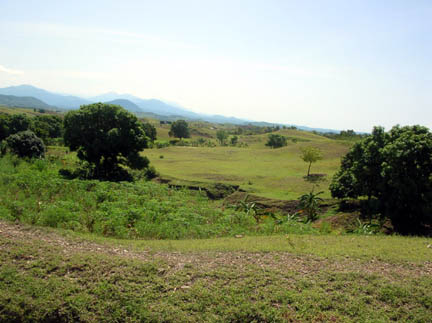
three to four hour ride. | The countryside is beautiful in this region. Here, the Artibonito River
rises to mountains on both sides of the border, the Dominican Republic on the right, Haiti on the left. |
 |  | The people tend to be happy, from childhood to adulthood. | The church plays an important role in the region, serving the mind, body,
and spirit of the residents. In both Banica and Pedro Santana, priests from the Arlington (Virginia) diocese have served
as pastor since 1991. | Church in Banica  | Church in Pedro Santana  |  | Each parish serves between 25 and 30 villages, called campos. Some of those villages
are long distances from the main church, a few only reachable by mule. But thanks to teams of volunteers from Northern
Virginia, especially students from George Mason University, Christen College, Marymount University, and local Catholic high
schools, each town now has its own chapel, like this one. | These parishes have built the St. Francis Meeting Center,
just on the outskirts of Banica, on the road to Pedro Santana. The Center serves as a meeting place for church groups
and also as the place where Medical Missionaries teams of doctors and nurses stay when they are serving the people of Banica
and Pedro Santana or on their way to Thomassique, Haiti. |  | In spite of the
beauty of the countryside, the happiness of the people, and the activities of the church, the region confronts many social
problems. Poverty is extreme; most households are subsistence farmers, whose crops are subject to damage from floods
during the six-month rainy season and drought during the six-month dry season. Malnutrition is not uncommon, especially
among the elderly and very young. Many houses are crumbling. Outside the main towns, most villages lack potable
water and many lack any water at all. Many children lack clothing and shoes. All of this contributes to reduced
life expectancy and high rates of infant mortality. Many of the diseases and health problems seen in clinics and hospitals
are directly related to contaminated water. | When families have land to grow on, they work hard under difficult
conditions. Almost all of the farming is done by hand, with whatever animals the family can own. |
 |  | Hard work
extends to even the youngest of the children. This young boy is headed to the public water fountain to bring water back
to his family. He will fill the jugs he has mounted on both sides of the burro. He is on the Dominican side of
the border; if he were on the Haitian side, he most likely would be on foot since most families there cannot afford to own
animals. |
On both sides of the border, most people get around on foot, bicycle, or motor bikes. Some
have burros or mules. Almost none have cars or trucks. |  |  | Housing is a real
problem throughout the region. This was home for a family of six until some people from the U.S. raised funds to build
them a new house. Now they live right next to their old house in a nice concrete home on a concrete foundation.
But even when families build new homes, they are still only about 400 to 450 square feet. | Some of the streets
of Banica are quite quaint. Although the houses are small and might lack indoor plumbing, they are well maintained. |  |  | The situation in
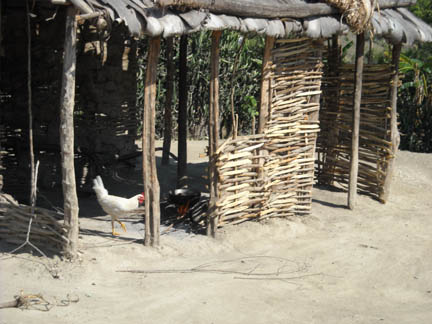
the outlying campos can be quite different. There, the homes are often made of sticks and mud, with a thatched roof
and mud floor. You can imagine that it does not provide much protection for the family during the rainy season.
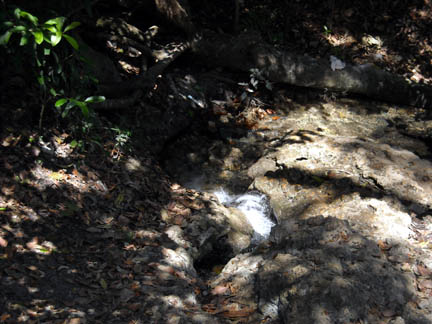
A family of five lives in this house. | Finding water is a major challenge in many villages. This is the main water
supply for one of the outlying campos of Banica. Someone from each house in the village makes the hike to the
pump at least once a day. Usually, that responsibility falls to the children or the woman. |  |  | There are
some places where water is plentiful. In those cases, it is used for many things: these women are doing the family laundry.
Some will bathe in the water before returning home. Some will fill jugs to bring water back to their families.
This is the same water their animals have visited earlier in the day. | One important need is to help the people of the region identify
and pursue new sources of income. One source that has great potential is Jatropha, a plant that grows well in semi-arid
environments and has a dense oil content, about ten times as dense as the oil in corn. Jatropha seeds can be pressed
with an inexpensive hand-press and the oil can be used immediately for cooking, lanterns, and to run diesel engines.
Medical Missionaries is sponsoring a pilot project which, if successful, will provide experience not only with growing and
processing the crop but also with several micro-enterprises that can be started around this crop. |  | There are signs
of development in Banica and Pedro Santana. This house, along the road between the two cities, was started in 2007.
By January 2008, it had been walled in (photo on the left). By January 2009, it was almost ready for occupancy (photo
on the right). |  |  | One other sign of development is this new factory that was opened in 2008. It will use the oil from a local tree
(higuereta) to make lubricants for autos and hair products. The hope is to eventually produce biofuels from this factory. |  |
No tour of Banica would be complete without a stop at the Cave of St. Francis, where legend has it that the Saint once prayed.
It is the site of a pilgrimage for tens of thousands of Dominicans every October. The cave is reached by a half-hour
trek off the road on the way out of town toward Pedro Santana. A path leads up a mountain to this opening to the cave. |  |  | Inside
the cave, there is evidence of its use for religious services. There are remnants from the pilgrims' visits (mostly
cloaks, crosses, and candles), as well as this raised platform from which sermons must be delivered. |
This tour has introduced you to some
of the people in the Banica and Pedro Santana region of the Dominican Republic and has shown you some of the conditions in
which they live. You can understand some of the many challenges they face. If you'd like additional information
about ways to help the people in this region, please contact Medical Missionaries. |
|